What is a tornado?
A narrow, spinning column of air that joins a thunderstorm to the ground. Small, short-lived and the most violent winds on Earth.
The definition
A tornado is a narrow, violently rotating column of air that reaches from a thunderstorm down to the ground. NOAA NSSL: Tornado basics
The Met Office describes a tornado as a rapidly rotating column of air reaching between the base of a storm cloud and the Earth’s surface. Met Office: Tornadoes
By definition, a tornado must touch the ground and a storm cloud at the same time. So “tornado on the ground” says the same thing twice. NOAA Storm Prediction Center: The online tornado FAQ
Funnel or tornado?
A spinning funnel that hangs from the cloud but doesn’t reach the ground is a funnel cloud. Once it touches the ground, it’s a tornado. NOAA NSSL: Tornado basics
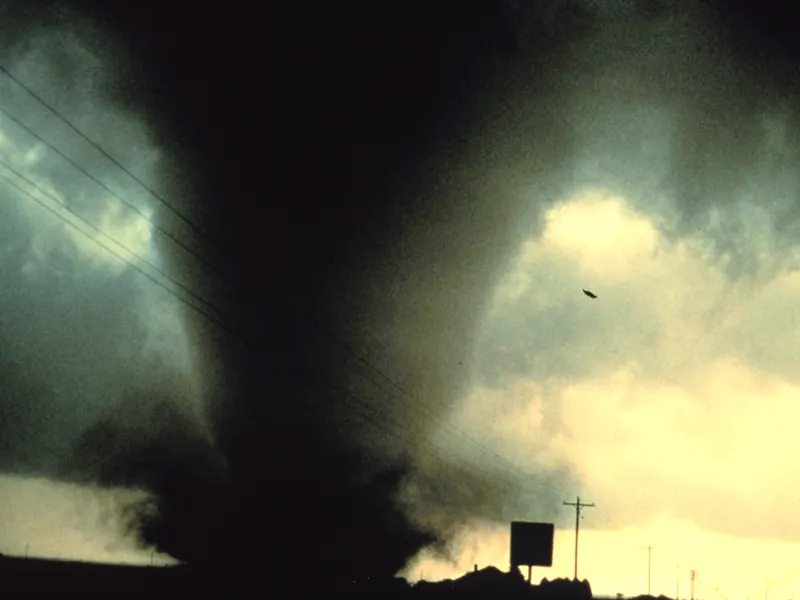
Wind is invisible, so you often only see a tornado when it forms a condensation funnel of water droplets, dust and debris. NOAA NSSL: Tornado basics A tornado can touch the ground without a full funnel. Sometimes the only sign is whirling dust or debris. NOAA NSSL: Tornado basics
How big, how fast, how long?
A typical tornado is 20 to 100 metres wide, lasts a few minutes and travels around a mile (1.6 km). Met Office: Tornadoes
Typical tornado winds are 75 to 100 mph (120 to 180 km/h). Met Office: Tornadoes
The largest, rarest tornadoes can be over 2 miles (3.2 km) wide, travel over 60 miles (100 km) and have winds above 300 mph (480 km/h). Met Office: Tornadoes
Tornadoes can last from a few seconds to more than an hour, but most last less than 10 minutes. NOAA Storm Prediction Center: The online tornado FAQ A typical tornado moves along at around 10–20 mph, but some barely move and others race along at more than 60 mph. NOAA NSSL: Tornado FAQ
Which way do they spin?
Most tornadoes spin anticlockwise in the northern hemisphere and clockwise in the southern hemisphere, but not all of them. NOAA Storm Prediction Center: The online tornado FAQ
A tornado that narrows can spin faster, just as an ice skater spins faster when they pull their arms in. NOAA Storm Prediction Center: The online tornado FAQ
No eye, but whirls inside
Unlike a hurricane, a tornado has no calm “eye”. Instead, it can have several smaller whirls, called subvortices, spinning inside it. NOAA NSSL: Tornado FAQ
Subvortices usually come in groups of 2 to 5 and last less than a minute each. They can add over 100 mph to the wind. NOAA Storm Prediction Center: The online tornado FAQ
What they look and sound like
Tornadoes can look white, grey, black, or even red: it depends on the light behind them and the dust and soil they pick up. NOAA Storm Prediction Center: The online tornado FAQ
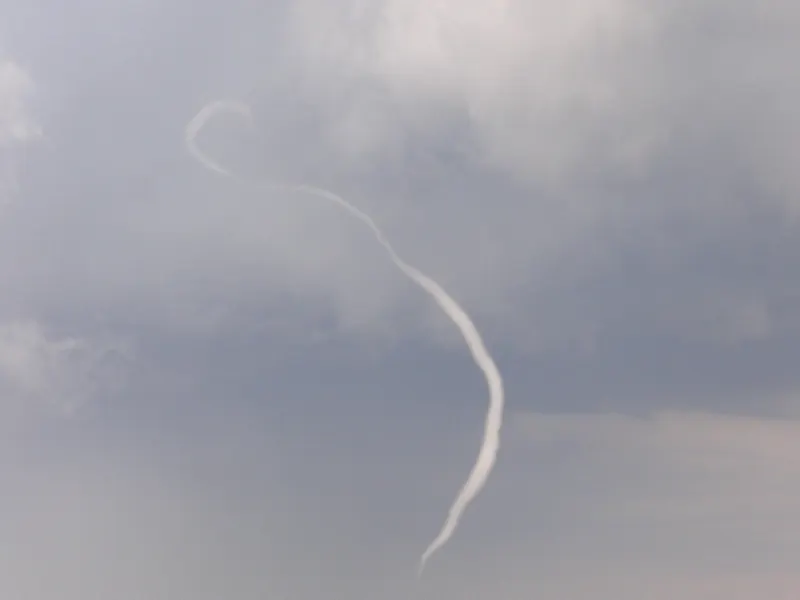
“Wedge” and “rope” are storm-spotters’ words for a tornado’s shape. Shape and size don’t tell you how strong a tornado is. NOAA Storm Prediction Center: The online tornado FAQ
People who have been near a tornado say it sounds like a jet engine or a freight train, and is very loud. NOAA NSSL: Tornado FAQ
An old name
Tornadoes used to be called cyclones. Today, “cyclone” usually means a much larger weather system. NOAA NSSL: Tornado FAQ
Next: how tornadoes form →