The EF, TORRO and IF scales
Nobody can stand in a tornado with a wind meter. So experts rate tornadoes from what they leave behind, or from their estimated wind speed.
Rated by the damage
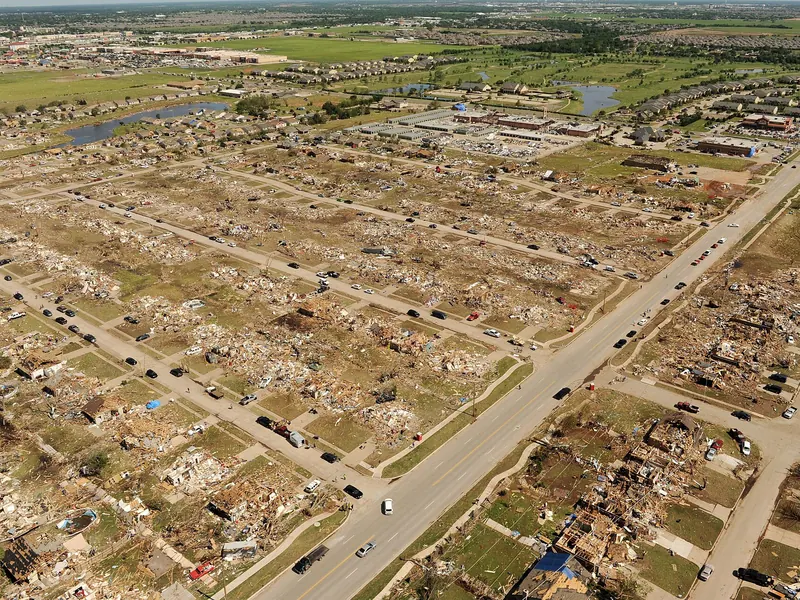
Tornado wind speeds are rarely measured directly. Experts look at the damage and work out what wind speed must have caused it. NOAA NSSL: Tornado basics Nobody knows the highest wind speed in a tornado: strong tornadoes destroy weather instruments. NOAA Storm Prediction Center: The online tornado FAQ
The Fujita and Enhanced Fujita scales
Dr Ted Fujita introduced the original Fujita (F) scale in February 1971. NOAA Storm Prediction Center: The Enhanced Fujita scale The Enhanced Fujita (EF) scale, an update by meteorologists and wind engineers, came into use in the USA on 1 February 2007. NOAA Storm Prediction Center: EF scale wind speeds
The EF scale uses 28 damage indicators, such as types of building and trees, each with 8 degrees of damage. NOAA NSSL: Tornado basics The EF scale is a set of wind estimates (not measurements) based on damage. NOAA Storm Prediction Center: EF scale wind speeds
| Rating | mph | km/h |
|---|---|---|
| EF0 | 65–85 | 105–137 |
| EF1 | 86–110 | 138–177 |
| EF2 | 111–135 | 179–217 |
| EF3 | 136–165 | 219–266 |
| EF4 | 166–200 | 267–322 |
| EF5 | over 200 | over 322 |
In the USA, a tornado rated EF2 or above counts as “significant”. Any tornado can still do harm. NOAA Storm Prediction Center: The online tornado FAQ
Old F-scale ratings were not changed: an F5 rated years ago is still an F5. NOAA NSSL: Tornado basics
A strong tornado that crosses open country with little to damage can end up with a low EF rating. NOAA NSSL: Tornado FAQ
The TORRO scale
The TORRO scale (T-scale), also called the International Tornado Intensity Scale, was devised in 1972 by Dr Terence Meaden in the UK. TORRO: The TORRO tornado intensity scale
TORRO describes its T-scale as a true wind-speed scale rather than purely a damage scale. TORRO: The TORRO tornado intensity scale
T0 starts at 17–24 metres per second (39–54 mph). The scale runs up to T10 (121–134 m/s, 270–299 mph) and beyond. TORRO: The TORRO tornado intensity scale
| Rating | Group |
|---|---|
| T0–T3 | Weak |
| T4–T7 | Strong |
| T8–T11 | Violent |
The T-scale is linked to the Beaufort wind scale: Beaufort force B = 2 × (T + 4). TORRO: The TORRO tornado intensity scale So a T0 tornado matches Beaufort force 8, and T1 matches force 10.
Most UK tornadoes have winds of up to 72 mph, which is T0 or T1 on the TORRO scale. Met Office blog: Tornadoes in the UK (22 Jul 2025)
The International Fujita scale
In Europe, the International Fujita (IF) scale was published on 28 July 2023. ESSL says the US EF scale was built for typical US structures and is hard to use elsewhere. ESSL: The International Fujita scale
Like the EF scale, the IF scale uses damage indicators and degrees of damage. Its ratings run IF0, IF0.5, IF1, IF1.5, IF2, IF2.5, IF3, IF4 and IF5. ESSL: The International Fujita scale
The fastest winds ever found
A mobile Doppler radar measured winds of about 301 mph (give or take 20 mph) just above the ground in the 3 May 1999 Bridge Creek–Moore tornado in Oklahoma: the highest winds ever found near Earth’s surface. NOAA Storm Prediction Center: The online tornado FAQ
Next: where tornadoes happen →